Corporate Travel Safety Without the Guesswork
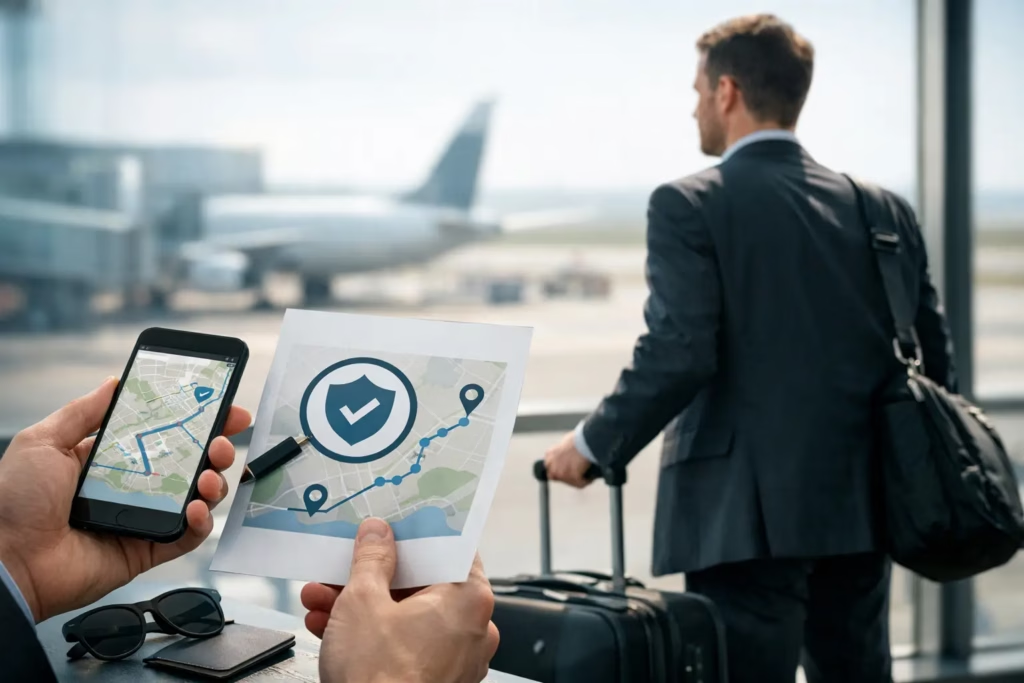
A delayed flight is inconvenient. A senior executive standing outside an unfamiliar terminal at midnight, trying to find a ride while their phone battery fades, is a corporate travel safety problem. The difference comes down to preparation: knowing who is responsible for the traveler, where the vehicle is, and what happens when the original plan stops cooperating.
Corporate travel is meant to create momentum for the business. It gets leaders to client meetings, teams to conferences, and guests to important events. But every trip also introduces moving parts that deserve more than a last-minute booking and a hopeful text message. A thoughtful safety program protects people, preserves productivity, and tells employees that their time matters.
Corporate Travel Safety Starts Before Departure
The safest business trip is not necessarily the most expensive one. It is the one with clear details, realistic timing, and support that does not disappear once an itinerary is emailed. Corporate travel safety begins when the company treats transportation, schedules, and communication as connected decisions rather than separate errands.
Assess the trip, not just the destination
A routine daytime airport transfer in a familiar city does not require the same planning as a late-night arrival, a winter drive through the mountains, or a multi-stop executive roadshow. Consider who is traveling, when they are moving, how much equipment they have, and whether they know the area.
A first-time visitor arriving in Calgary during a snowstorm may need a different level of support than a local employee heading to a downtown meeting. A team traveling to Banff, Canmore, or Lake Louise should also account for changing road conditions, seasonal traffic, and the simple fact that remote routes offer fewer convenient backup options.
This is not about making every itinerary feel dramatic. It is about applying the right level of care to the actual conditions of the trip.
Build time into the itinerary
Tight schedules look efficient until a flight delay, baggage issue, or traffic slowdown turns them into a chain reaction. Leave reasonable room between arrival and meetings, airport and event venue, or one client visit and the next. That buffer is not wasted time. It is what allows travelers to arrive composed instead of rushed.
For executives and client-facing teams, a calm arrival has real value. Nobody wants to begin a high-stakes presentation after sprinting through a terminal or negotiating with an unfamiliar driver at the curb.
Make Ground Transportation Part of the Safety Plan
The flight may get most of the attention, but ground transportation is often where travel plans become unpredictable. A traveler can be carrying confidential materials, wearing business attire, arriving in an unfamiliar neighborhood, or moving after dark. The ride from the airport is not an afterthought. It is the first operational handoff of the trip.
A professionally managed car service gives companies more control over that handoff. The vehicle, chauffeur, pickup instructions, and contact information are confirmed in advance. The traveler knows what to expect, and the travel coordinator has a reliable point of contact if plans change.
That does not mean every corporate trip requires a limousine. Vehicle choice should fit the traveler and the assignment. A luxury sedan may be ideal for one executive, while an SUV offers more room for luggage or winter travel. A sprinter van or group shuttle can keep a conference team together instead of scattering employees across multiple vehicles and arrival times.
The standard should be straightforward: choose transportation that is appropriate for the schedule, location, weather, passenger count, and level of responsibility involved.
Why a chauffeur changes the equation
A vetted, professional chauffeur is more than someone behind the wheel. They are a trained hospitality professional who understands timing, discreet service, safe driving, and the importance of a polished arrival. For a visiting client or an executive traveling alone, that level of professionalism brings welcome peace of mind.
It also reduces unnecessary friction. Rather than asking a traveler to navigate pickup zones, compare vehicles, or communicate with multiple parties after a delayed flight, a chauffeured service provides one organized plan. At Cascade Limo, real-time ride communication helps travelers and coordinators stay informed without turning a simple airport transfer into a group text crisis.
Keep Communication Clear and Useful
Travel safety depends on communication, but that does not mean employees need to report every coffee stop. The goal is to make essential trip details easy to access and easy to act on.
Before departure, travelers should have a clean itinerary with flight information, hotel details, meeting locations, ground transportation contacts, and a company emergency contact. For complex trips, include clear pickup instructions and a backup plan for delays or cancellations.
The travel coordinator should also know how to reach the traveler and transportation provider without searching through old email threads. A live update confirming that a chauffeur is en route or waiting at the airport may seem small, but it removes uncertainty at exactly the moment travelers need clarity.
For leadership teams, discretion matters too. Good communication should be purposeful, not intrusive. Share what supports safety and logistics, protect personal information, and avoid creating a process so cumbersome that people work around it.
Give Travelers the Tools to Make Good Decisions
Corporate policies work best when they support sound judgment rather than trying to control every minute of a trip. Employees should know what to do when a flight is canceled, a meeting runs late, a hotel location feels unsafe, or a planned ride fails to arrive.
Practical guidance can cover a few core expectations: use approved transportation providers for designated trips, avoid sharing sensitive business information in public settings, keep devices charged, and report significant itinerary changes through the appropriate channel. International travel may call for more detailed guidance around documents, local laws, connectivity, and emergency assistance.
The tone matters. Travelers should feel comfortable raising a concern without worrying that they are creating extra work or overreacting. Someone who has a bad feeling about a pickup location, an unfamiliar vehicle, or a late-night route should have permission to choose the safer option and contact support.
Prepare for Disruptions Without Making Them Bigger
Even excellent planning cannot prevent every disruption. Weather grounds flights. Conferences run late. A road closure changes the route. The point of a corporate travel safety plan is not to promise perfection. It is to ensure that no one is left improvising alone when conditions change.
Start with a simple escalation process. Travelers should know who to contact after hours, while coordinators should know who can authorize a hotel extension, replacement transportation, or itinerary change. Keep the decision-making chain short enough to be useful. If an employee needs three approvals to arrange a safe ride after a canceled flight, the policy is not serving its purpose.
Transportation partners should be included in this plan. Confirm how they handle schedule changes, flight monitoring, substitutions, and late-night pickups before the trip begins. Transparent pricing also matters during disruption. Businesses should understand what is included, what may change, and whom to call before an unexpected charge becomes another problem to solve.
Treat Safety as Part of the Guest Experience
For many companies, business travel is also an extension of their brand. The way a company moves executives, employees, recruits, and clients says something about its standards. A clean vehicle, courteous chauffeur, accurate pickup, and thoughtful timing create a feeling of confidence before anyone enters the meeting room.
There is a practical return on that experience. Travelers who feel supported are more likely to arrive focused, on time, and ready to represent the organization well. Clients who receive reliable transportation are less likely to remember the logistics at all, which is usually the highest compliment a travel plan can earn.
The right approach will vary by company size, travel volume, and risk profile. A small business may begin with approved transportation for airport and late-night travel, while a larger organization may build detailed protocols for executive trips, conferences, and group shuttles. Both can make meaningful progress by replacing assumptions with clear arrangements.
The next time a business trip is booked, look beyond the departure time. Ask who is meeting the traveler, how changes will be communicated, and whether the plan still works if the day goes sideways. That is where first-class travel begins: not with a vehicle at the curb, but with the confidence that someone has already thought ahead.